

Meet the young people behind YCD’s Farmer Guide and the skills, challenges and aspirations driving their work.
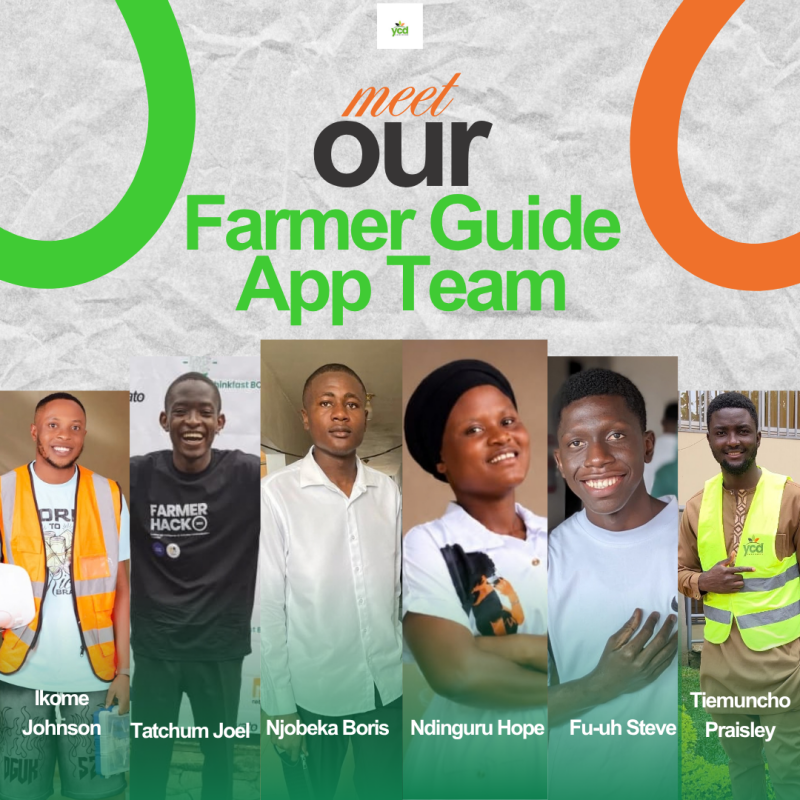
A solution does not always begin in a laboratory, a large company or a well-funded organisation.
Sometimes, it begins with young people looking at a problem around them and asking: What can we do with the skills we have?
For YCD, that question brought together a team of young Cameroonians around an idea: using technology to develop a tool that could help farmers access information, identify crop problems and connect with better opportunities.
That idea became YCD’s Farmer Guide.
The project has since moved from an idea to a functional application that is now entering a crucial stage: testing with users and improving the tool based on what they learn.
But behind the application is another story — the story of the young people building it.
Different skills, one project
The Farmer Guide team does not come from one background.
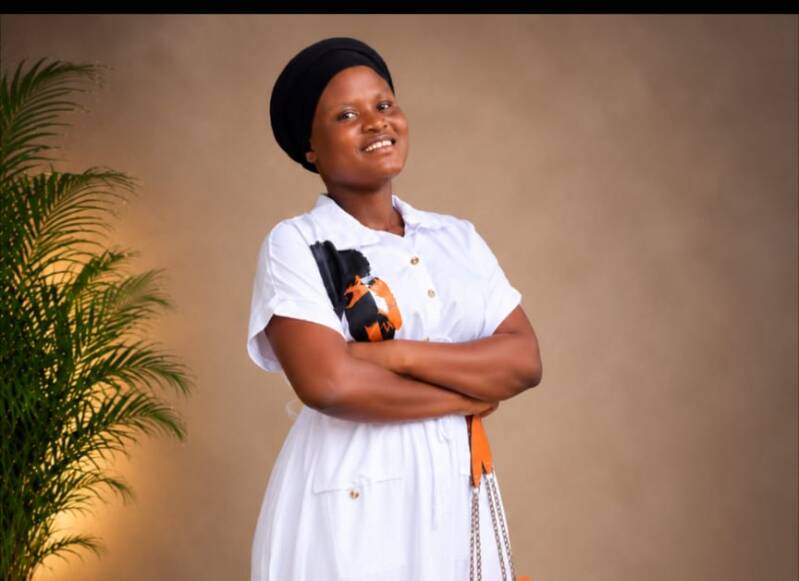
Ndinguru Hope Nchounyui studies Agricultural Engineering. Her contribution has included research and pitching, bringing an agricultural perspective to a project that is ultimately designed to serve farmers.
For Hope, joining the project was an opportunity to contribute to sustainable development and make a difference in her community and country.

Njobeka Boris Beyieh, who studies at Yaoundé International Business School while developing his skills as a software developer, joined because he wanted to use technology to address real problems faced by farmers.
His contribution has focused on software development, technical features, functionality and user experience, alongside testing, problem-solving and contributing ideas to the team.

For Tiemuncho Praisley Fiagmenyi, who studies Software Engineering and is also a professional graphics designer, the project created an opportunity to contribute through visual design, communication and pitching.

Fu-uh Steve Junior A., a Software Engineering student and web developer, brought software and web development skills to the team, as well as contributing to project coordination and helping turn ideas into a working product.

Ikome Monde Briayan Johnson, a final-year Network Engineering student at Biaka University Institute of Buea, brought experience in software development, ICT projects and technology-for-development initiatives. His contribution has included developing the mobile application, connecting features to the backend, working on the crop disease detection system, supporting product design, testing, pitching and project coordination.
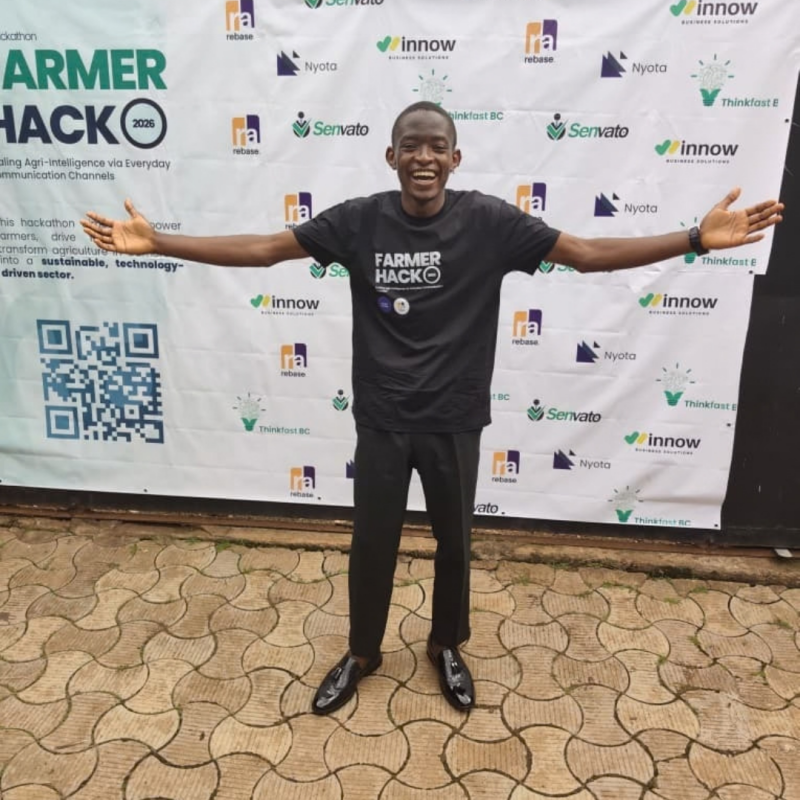
And Mkounga Tatchum Laurent Joel, who holds a degree in Computer Science and Software Engineering and is developing his skills in Artificial Intelligence and Machine Learning, contributed to backend development, system design, database management, research, testing and technical problem-solving.
Different skills became different pieces of the same puzzle.
When skills meet a real problem
For the team, the Farmer Guide is not simply a technology project.
It is an attempt to use technology in response to challenges that farmers actually experience.
Boris explains that his motivation was to use technology to solve real problems faced by farmers and contribute to improving agriculture through digital innovation.
Steve joined for a similar reason: he wanted to use technology to help farmers who lose crops to diseases and struggle to find markets.
Johnson was drawn to the project because many smallholder farmers still struggle to access timely information about diseases, weather, farming practices and markets. What attracted him most was that the project was not simply about building another app.
“The idea was to build something that could actually be used by farmers and help them make better decisions.”
For Laurent, the attraction was also the possibility of building technology with a practical purpose — improving farmers’ access to information, resources and opportunities.
This is where the different skills become important.
Software development can turn an idea into a functioning application. Research can help the team understand the problem. Agricultural knowledge can help ensure that the solution speaks to farmers' realities. Design and communication can make the product and its message easier to understand. Pitching can help the team explain the idea and bring others into the conversation. Product thinking can help the team consider not only what is technically possible, but what is genuinely useful from a farmer’s perspective.
The project has given these young people a chance to put their skills to work beyond the classroom.
Building it hasn't always been easy
The team has also learned that having an idea is one thing. Building something that works for real people is another.
Hope's biggest challenge was finding farmers willing to collaborate by answering questions and testing the application. She also had to manage her time around unforeseen circumstances.
For Boris, one of the key challenges was making sure the application was technically functional while also keeping it simple enough for farmers to use. Testing revealed areas that needed improvement, requiring the team to adjust some features based on feedback and user needs.
Johnson also learned that some features that appeared simple on paper could become much more complicated during actual testing. The marketplace and payment process did not initially work exactly as the team had envisioned. Although farmers were interested in buying and selling, the payment integration was not yet fully ready, meaning some transactions still had to be coordinated through WhatsApp.
That experience reinforced the importance of building with users, rather than relying only on assumptions about what they need.
“We have to continuously test with them, listen to their feedback, and make changes based on how they actually use the platform.”
The technical side presented its own challenges.
Steve recalls struggling with the disease-detection AI model, particularly the difficulty of training it accurately with limited local data.
Laurent similarly describes the challenge of balancing technical requirements with limited time and resources, while making sure the application continued to respond to the actual needs of farmers.
Johnson also recognises that there are still technical issues to solve, particularly around payments, scalability and making the user experience as simple as possible.
And there were challenges outside the code itself.
Praisley had to work under tight deadlines while preparing a PowerPoint presentation for a pitching session. The team also learned an important lesson about how much information to share publicly. After realising that they had disclosed more about the project than they should have, they had to rethink how they communicated some of their work in order to protect their intellectual property.
These experiences are part of the development process.
The team did not have every answer at the beginning. They encountered problems, received feedback, adjusted and continued.
From building the app to testing it
The team has already taken the Farmer Guide through pitching and competition spaces, including Impact Month 2026, where the project placed second, and Farmer Hack 2026, where it placed third.
Those experiences required the team to do more than build.
They had to explain the problem, present their solution, answer difficult questions and listen to feedback.
Now, the project is entering another kind of test.
The Farmer Guide is being tested with users – the farmers.
For the team, reaching this stage represents progress — but not the end of the work.
Boris describes having a working prototype that can be tested with users as a major achievement. He sees the testing stage as an opportunity to identify weaknesses and make the application more practical and reliable.
Hope shares a similar sense of accomplishment, while recognising that there is still work to be done.
Laurent describes the stage as both exciting and rewarding: the idea has become a functional application, but continued testing and improvement are still necessary.
For Steve, seeing the project move from an idea to testing is already a significant achievement.
Johnson is proud that the team has moved from an idea to a working platform that can be placed in the hands of real farmers and tested in real conditions. At the same time, he does not see testing as the finish line.
“We are no longer asking, ‘Can we build this?’ We are now asking, ‘How do we make this work really well for the people we built it for?’”
And Praisley sees the current stage as an important first step in a much bigger journey.
What do they hope comes next?
Ultimately, the team is not building the Farmer Guide simply to have an app.
They want it to be useful.
Hope hopes farmers will feel confident turning to the platform when they encounter problems and that its marketplace can help them earn more from what they work so hard to produce.
Boris hopes the application can become a reliable digital tool that helps farmers identify crop problems, access expert advice, find markets and ultimately improve their productivity and income.
Steve hopes it can help reduce crop losses for smallholder farmers, connect them more directly with consumers and eventually expand beyond Cameroon.
Laurent imagines the Farmer Guide becoming a reliable digital companion for farmers — one that provides agricultural information, guidance, weather updates and market opportunities, while helping farmers make better decisions and connect their work to better economic opportunities.
Johnson hopes the Farmer Guide becomes a tool that farmers can genuinely depend on. He wants farmers to be able to take a picture of a sick crop and receive useful guidance, access information that supports better farming decisions, connect with agricultural experts when they need additional help and find better opportunities to sell their produce.
Beyond the technology itself, he hopes the project can contribute to better incomes, reduced avoidable crop losses and stronger food security for farming communities.
Praisley’s vision is broader still: a practical tool that can help African farmers scale, contribute economic value and address wider challenges around food security and decent work.
Their individual goals are different, but they share a common thread:
They want the technology they are building to be useful to the people it was built for.
Young people as problem-solvers
The Farmer Guide is still a work in progress.
There are features to improve, more testing to conduct, feedback to understand and challenges still to solve.
But the journey already demonstrates something important.
Young people do not have to wait until they have all the answers, all the resources or years of experience before they can begin contributing to problems around them.
They can start with what they know.
They can learn from what they don't know.
They can build, test, receive criticism, make changes and try again.
For YCD, that is an important part of what youth empowerment can look like in practice.
The Farmer Guide is not only about developing a digital solution for farmers. It is also about creating space for young people to apply their skills, collaborate across different areas of expertise, learn through experience and contribute to a real community challenge.
The app is still being tested, and its journey is still unfolding.
But behind it is already a story worth telling: young Cameroonians learning, building and using what they know to try to create something useful for others.
And the next chapter will be shaped not only by the team behind the app, but by the farmers who test it, use it and tell them what needs to improve.